An early commitment dominates
Once a wrong assumption is anchored, the trajectory becomes prefix-dominant: later computation refines the error's consequences rather than revising its root cause.
Fudan University · Shanghai Innovation Institute · ACL 2026 (Findings) · arXiv:2601.11940
ACL 2026 · Findings
Thinking Traps — after an early wrong commitment, a model elaborates a self-consistent but incorrect prefix. TAAR cuts before the trap and restarts the thought.
Don’t argue with the trap. Leave it.
The one idea
Long chain-of-thought scales test-time compute — but longer traces also demand the ability to revise early assumptions. In many failed runs an early wrong commitment dominates everything after it: even when the model later reflects, verifies, or tries an alternative, it refines the error's consequences instead of fixing the root cause. We call this prefix-dominant deadlock a Thinking Trap — and on a curated DAPO-MATH subset, 89% of failures are traps.
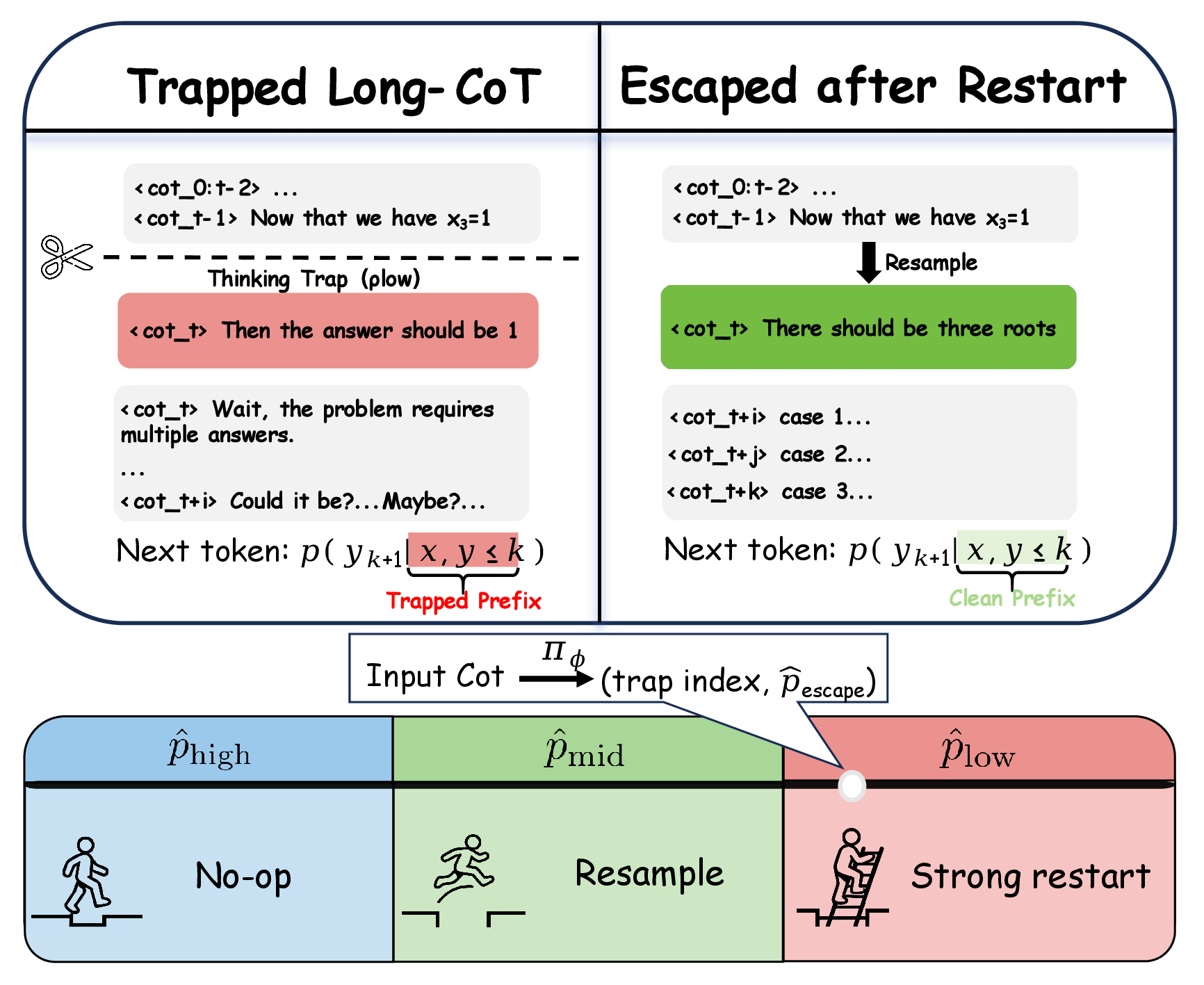
Once a wrong assumption is anchored, the trajectory becomes prefix-dominant: later computation refines the error's consequences rather than revising its root cause.
Downstream self-repair — reflection, verification, alternative attempts — largely doesn't work: keeping the trapped prefix and correcting after it escapes far less often than cutting the trap out.
Traps aren't just another error category: they burn large token budgets without buying correctness. Removing them is where extra compute actually pays off.
How TAAR works
TAAR is a test-time controller — it never fine-tunes the base reasoning model. A lightweight diagnostic policy reads a partial trajectory and predicts two signals: where the trap is and how deep it is; the controller then reallocates compute from the trapped continuation toward a fresh re-derivation.
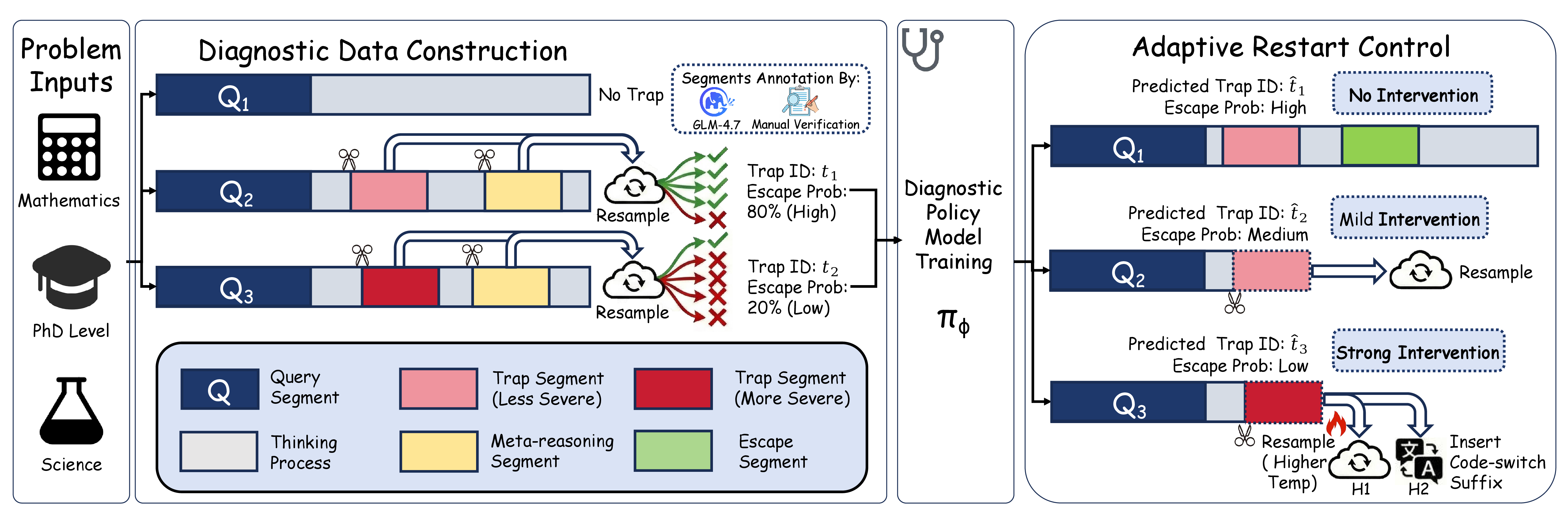
A Qwen3-4B policy, SFT'd on GLM-4.7-judged trajectories (93% human agreement), reads a segmented prefix and predicts the earliest wrong-commitment segment (t̂) and how escapable the trap is (p̂) — from as little as 20% of the trace.
Instead of correcting after the error, TAAR keeps only the prefix before the predicted trap segment, Y<t̂, and regenerates from there — removing the wrong commitment from the effective context.
p̂ gates the intervention: ≥ 0.6 step over (keep going), 0.1–0.6 mild resample, ≤ 0.1 strong — higher-temperature resampling with an optional structured reboot suffix that requests a fresh derivation and a constraint checklist.
TAAR touches no base-model weights and uses no ground-truth answers at test time. It is a controller, not a new model — the diagnostic policy decides only where to cut and how strongly to restart under a fixed compute budget.
Why cut, not correct?
Two measurements justify TAAR's design. First, where you cut matters enormously: removing the trap beats correcting after it. Second, the trap can be spotted early, so control can happen online — before the long chain even finishes.
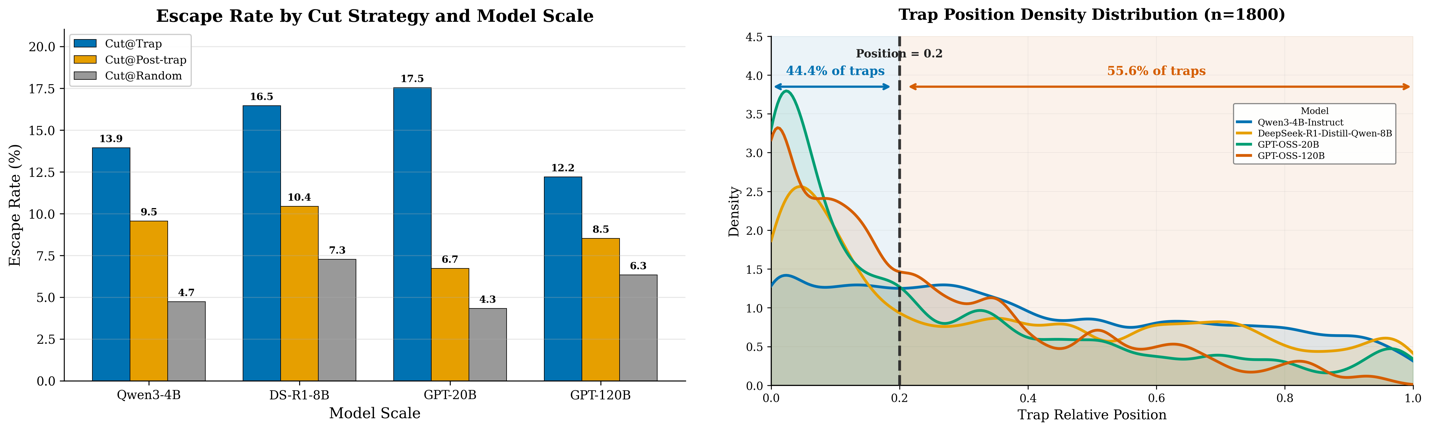
Restarting at the trap segment reaches the answer 17.5% of the time vs 6.7% from post-trap reflection windows and 4.3% from random cuts (20B; the same ordering holds at 4B and 8B). Prefix-dominance makes late fixes weak.
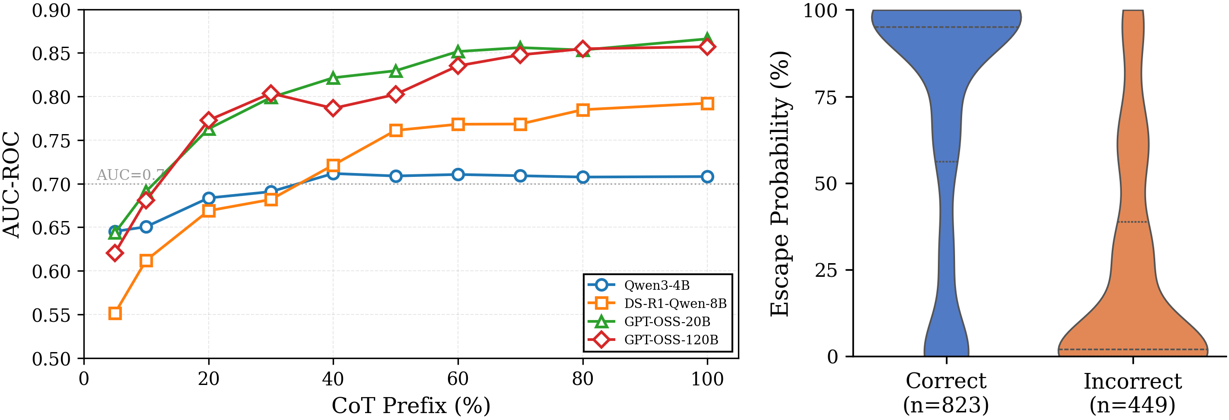
Trap detection exceeds 0.7 AUC with only 20% of the trajectory and saturates by 40–60% — so TAAR can decide whether to intervene online, without waiting for the full chain.
The predicted escape probability is discriminative — correct trajectories cluster near 0.95, incorrect ones near 0.40 — a usable control signal for how strongly to restart.
The payoff
Under a matched budget of K=4 sampled paths, TAAR reallocates compute from trapped continuations toward genuinely different solution paths — lifting accuracy on five hard math and science benchmarks without changing a single base-model weight.
On DeepSeek-R1-8B, TAAR reaches 69.1 average vs 64.5 (AVG@4) and 66.0 (PRM@4) — +4.6 / +3.1 — with the largest gains on the hardest suites (HMMT25 +7.5, BRUMO25 +5.9, AIME24 +5.0). The 4B model gains +1.7 and the 20B model +1.5, all without fine-tuning base weights.
TAAR tops both standard multi-sample averaging (AVG@4) and an outcome-based process-reward selector (PRM@4) on the mid-scale 8B model, and is competitive at 4B and 20B — reallocating budget beats re-ranking trapped candidates.
Gains concentrate where reasoning is fragile. On the very strong 120B model TAAR is competitive but not consistently ahead (79.2): when prefixes are already near-correct, aggressive restarts can discard useful work — an honest limit of trap-cutting.
TAAR spends the same tokens differently. It never edits base weights, never sees gold answers at inference, and localizes over paragraph segments — so boundary ambiguity and judge-label noise are real limits. The gain is structural: stop pouring compute into a trapped prefix.
Built from 4 models (4B–120B) · 5 benchmarks · 6,000 trajectories Qwen3-4B · DeepSeek-R1-8B · GPT-OSS-20B / 120B · AIME24 · AIME25 · BRUMO25 · HMMT25 · GPQA-Diamond · K=4 budget · GLM-4.7 judge (93% human agreement)
Watch
Cite
@misc{chen2026thinkingtraps,
  title   = {Thinking Traps in Long Chain-of-Thought:
             A Measurable Study and Trap-Aware Adaptive Restart},
  author  = {Chen, Kang and Yu, Fan and Nian, Junjie and Zhao, Shihan and
             Feng, Zhuoka and Yao, Zijun and Wang, Heng and Yu, Minshen and Cao, Yixin},
  year    = {2026},
  eprint  = {2601.11940},
  archivePrefix = {arXiv},
  primaryClass = {cs.AI},
  note    = {TAAR — Trap-Aware Adaptive Restart. ACL 2026 Findings},
  url     = {https://arxiv.org/abs/2601.11940},
}
Don’t argue with the trap. Leave it — and restart the thought.