Outputs are a projection
Token probabilities and confidence scores are low-dimensional read-outs of a much richer internal state — a thin shadow of the dynamics that produced them.
Fudan University · ICML 2026 (Spotlight) · arXiv:2510.26277
ICML 2026 · Spotlight
Neuron Agreement Decoding — unsupervised answer selection from internal signals
Don't read what it answered — watch which neurons agree.
The one idea
To pick the best of many sampled reasoning chains without a ground-truth label, decoders usually score the output — token probabilities, entropy, self-evaluations, or a majority vote over answer strings. After post-training those output signals are often poorly calibrated, and a vote needs comparable strings to count. NAD looks one layer down: at which internal neurons each chain switches on while it reasons.
Token probabilities and confidence scores are low-dimensional read-outs of a much richer internal state — a thin shadow of the dynamics that produced them.
For each sampled chain, record the set of neurons that activate above threshold during generation — a fingerprint produced online from the hidden state, never decoded back into text.
Score chains by how much their activation sets overlap, and return the one in the densest agreement basin. The answer string is read only once, after the internal-signal decision.
What the activations show
Across models and benchmarks, two regularities make internal signals usable for selection — correlations, read as evidence, not as proof that a model "knows" it is right.
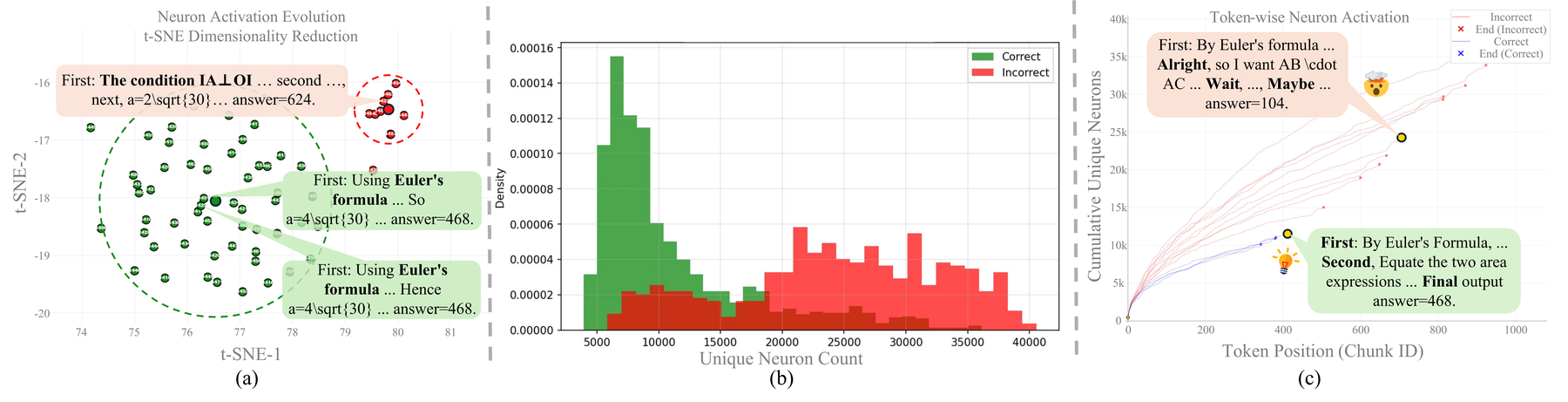
Correct responses activate substantially fewer unique neurons than incorrect ones, throughout generation. Successful chains seem to reach an answer with less trial-and-error; failures over-explore, lighting up many scattered neurons.
Activations from correct responses show stronger cross-sample agreement — they overlap in neuron space and cluster tightly. Incorrect ones diverge and sit at the margins. Consensus among chains tracks correctness (correlated, not causal).
Sparse and self-agreeing means the most-agreed-upon chain is a strong unsupervised pick. NAD turns these two regularities into a single selection rule — no answer strings required.
How NAD works
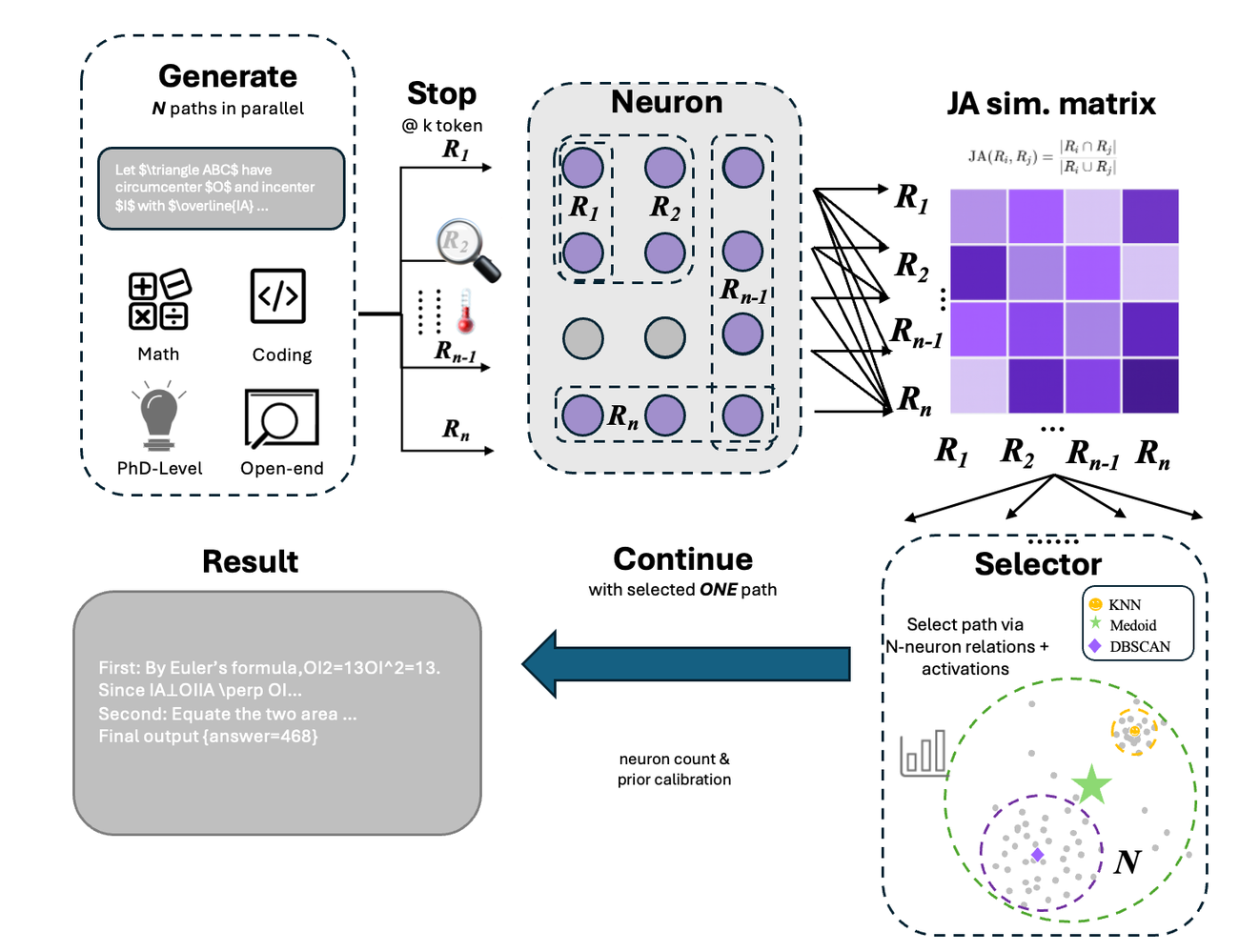
Draw N=64 chains per question. For each chain i, collect the set of neurons that fire above a threshold during generation — a binary activation fingerprint, computed online from the hidden state.
Pairwise set similarity forms an N×N consensus matrix. Jaccard is the shared activated neurons over the total — high when two chains light up the same circuitry.
Score each chain by its summed agreement with its k nearest neighbours (kNN-agreement), or its agreement with all others (global medoid). NAD returns the chain at the centre of the densest consensus — no labels, no execution, no answer strings.
NAD touches token ids only to find generation boundaries, never their contents. It uses no correctness labels, execution results, or answer-token text. Majority voting counts answer strings; NAD aggregates neuron agreement.
Where it lands
Same selector, two regimes: where majority voting is defined, NAD matches it; where it is not, NAD still picks — reading no answer strings.
On math & science with verifiable answers, NAD matches majority voting (Cons@64); on open-ended code, where voting is undefined, it beats Avg@64. Everything from internal activations — no answer strings. (NAD-kNN, Qwen3-4B-Think: AIME 85.0 · GPQA 71.7 · HumanEval 97.0 · LCBv5 62.3 · MBPP 86.4.)
Reading no answer strings, NAD tracks the majority vote it never sees — AIME24+25 85.0 (vs Cons@64 86.7, Avg@64 74.6) and GPQA 71.7 (above Cons@64's 68.2). The internal-agreement signal recovers what string voting recovers, without the strings.
Code outputs are near-unique strings, so an exact-string majority collapses. The same selector still returns a direct pass@1 and consistently beats Avg@64 — HumanEval 97.0, LiveCodeBench v5 62.3, MBPP 86.4 — exactly where text voting cannot run.
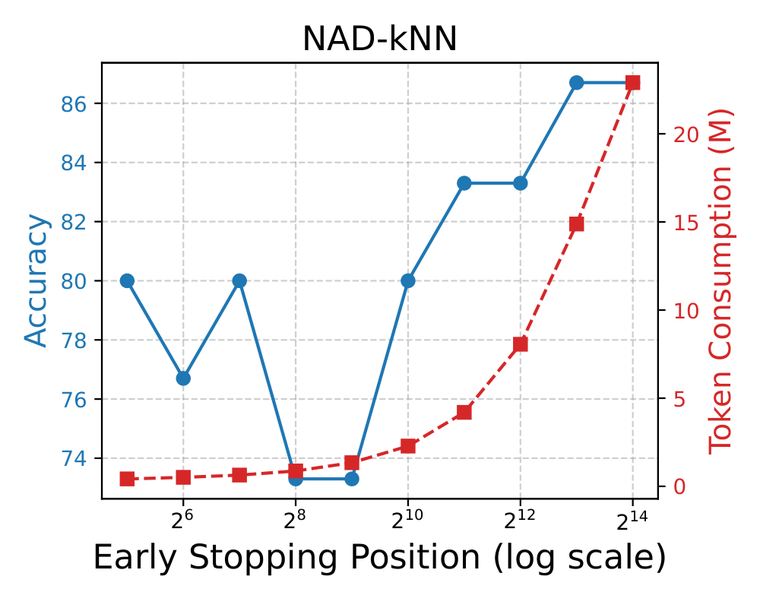
NAD selects the most agreed-upon trajectory, which correlates with correctness — it does not certify it. If a model produces a denser cluster of wrong answers than right ones, NAD can follow it, exactly as textual majority can follow a confident wrong consensus.
Evaluated across 3 reasoning models · 5 benchmarks · 64 samples / question Qwen3-4B-Think, R1-Qwen3-8B, Qwen3-4B-Instruct · AIME24/25, GPQA, HumanEval, LiveCodeBench v5, MBPP · temperature 0.6
Watch
Cite
@misc{chen2025nad,
  title   = {Do LLMs Signal When They're Right? Evidence from Neuron Agreement},
  author  = {Chen, Kang and Wang, Yaoning and Xiong, Kai and Feng, Zhuoka and
             Sun, Wenhe and Chen, Haotian and Cao, Yixin},
  year    = {2025},
  eprint  = {2510.26277},
  archivePrefix = {arXiv},
  primaryClass = {cs.CL},
  note    = {Neuron Agreement Decoding (NAD). ICML 2026 (Spotlight)},
  url     = {https://arxiv.org/abs/2510.26277},
}
Correct = Sparse + Consistent.