Specialists are brittle
An agent tuned for one benchmark degrades sharply on another. Maintaining a separate expert per environment — or retraining one model over all of them — is costly to build and to serve.
Fudan University · Shanghai Innovation Institute · EMNLP 2026 (Main) · arXiv:2601.07309
EMNLP 2026 · Main Conference
ARM — role-conditioned neuron transplantation that merges benchmark-specialist agents into a single deployable model, without any gradient optimization
Keep every expert’s edge. Pay no training cost.
The one idea
Fine-tuned LLM agents are strong inside the environment they were trained on and brittle everywhere else: change the tool schema, the action interface, or the trajectory distribution and accuracy drops. Retraining one model across every environment is expensive and finicky. Model merging is the training-free alternative — fold several same-architecture experts into one model — but on multi-turn agents naïve merges are unstable, and small errors on role-critical spans (a malformed tool call, a broken action) cascade into long-horizon failure.
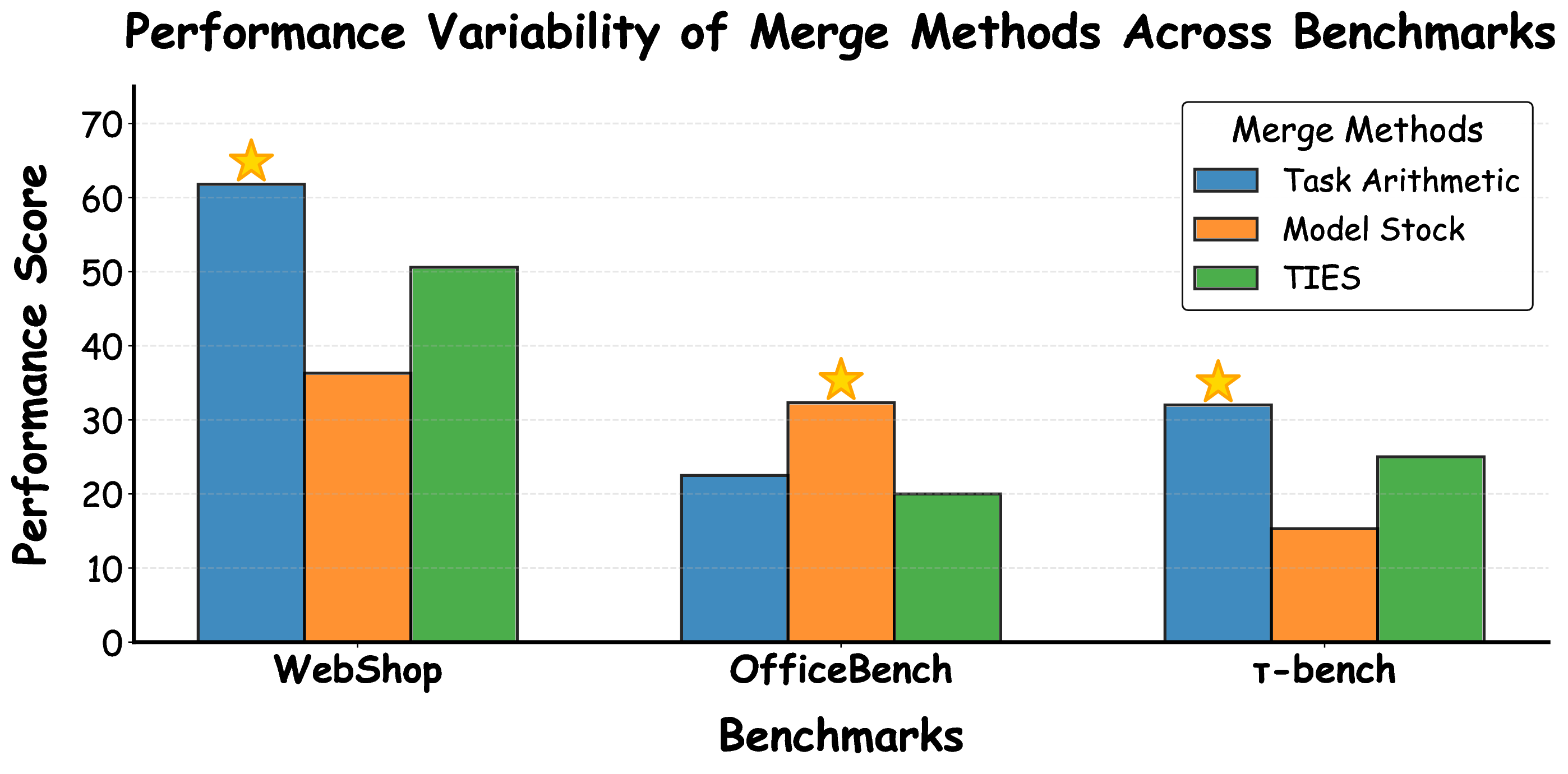
An agent tuned for one benchmark degrades sharply on another. Maintaining a separate expert per environment — or retraining one model over all of them — is costly to build and to serve.
Weight-space merges need no training, yet different operators trade suites off against each other, and interference on role-critical tokens triggers cascading failures in multi-turn rollouts.
Choose a stable backbone with an answer-free signal, then repair the weakest suite by grafting a few role-salient neurons — while protecting the neurons every other suite depends on.
How ARM works
ARM is a three-stage, gradient-free pipeline. It never optimizes weights end-to-end and never reads answer strings to choose a model: selection is driven purely by where each expert’s role-critical neurons fire.
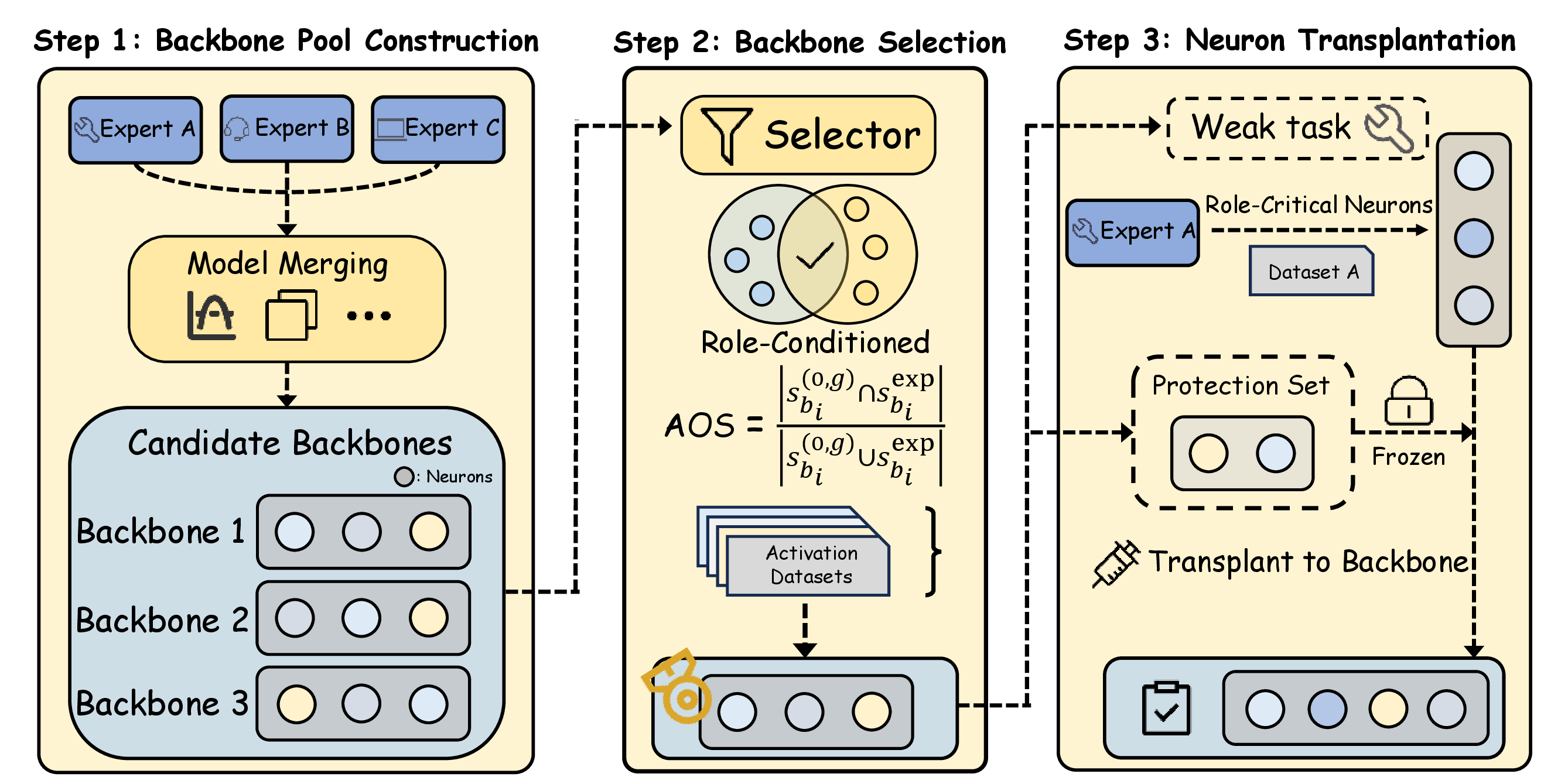
Apply a set of standard training-free weight-space operators — uniform averaging, task arithmetic, TIES — to the same-architecture experts, producing a small pool of candidate merged backbones instead of committing to one recipe.
On a lightweight calibration set, trace role-conditioned MLP activations and measure how well each candidate preserves an expert’s role-salient neurons. Pick the backbone that maximizes mean Activation-Overlap Score — no interactive evaluation, no answer strings.
For the dev-diagnosed weak suite, transplant a small top-k% of the donor expert’s role-salient MLP neurons into the backbone — but only those not salient for any other benchmark. Protecting shared neurons keeps repair local and avoids negative transfer.
Every stage is training-free: no gradients, no router edits, no changes to quantization or decoding. ARM edits a single merged checkpoint at the neuron level. Selection is answer-string-free — it reads activation geometry, not outputs.
Why it works
The transplant only helps if a suite’s salient neurons are actually distinct. ARM’s analysis shows that conditioning the trace on role-critical spans yields more benchmark-specific neuron sets than un-conditioned tracing — the sets overlap less, so a graft can lift the weak suite without disturbing the others.
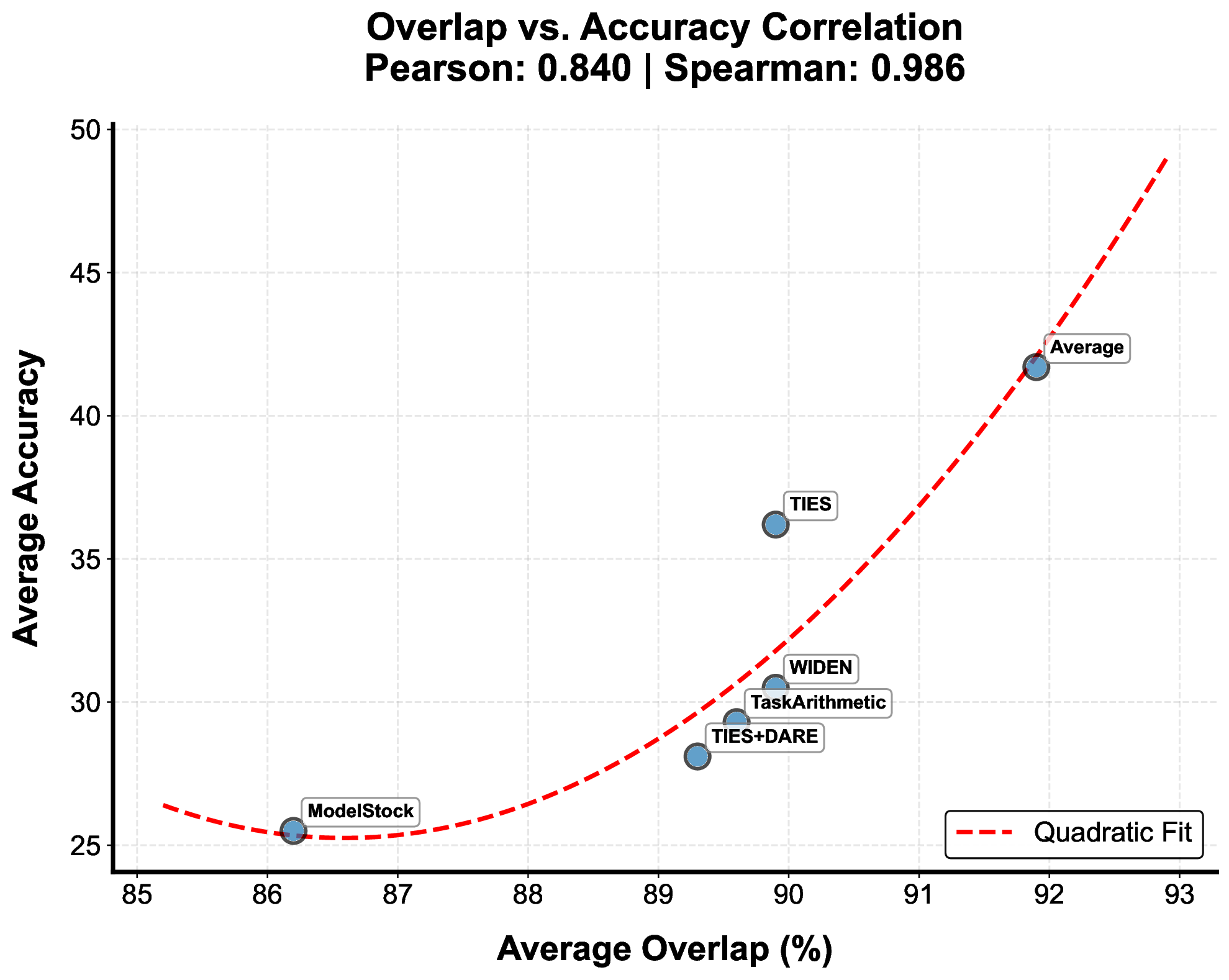
The answer-free overlap score correlates strongly with downstream accuracy across candidates (Pearson r≈0.84, Spearman ρ≈0.99) — enough signal to rank backbones without running the interactive benchmarks.
Conditioning activation tracing on role-critical tokens produces sharper, less-overlapping salient sets per benchmark — the precondition for conflict-aware, localized repair.
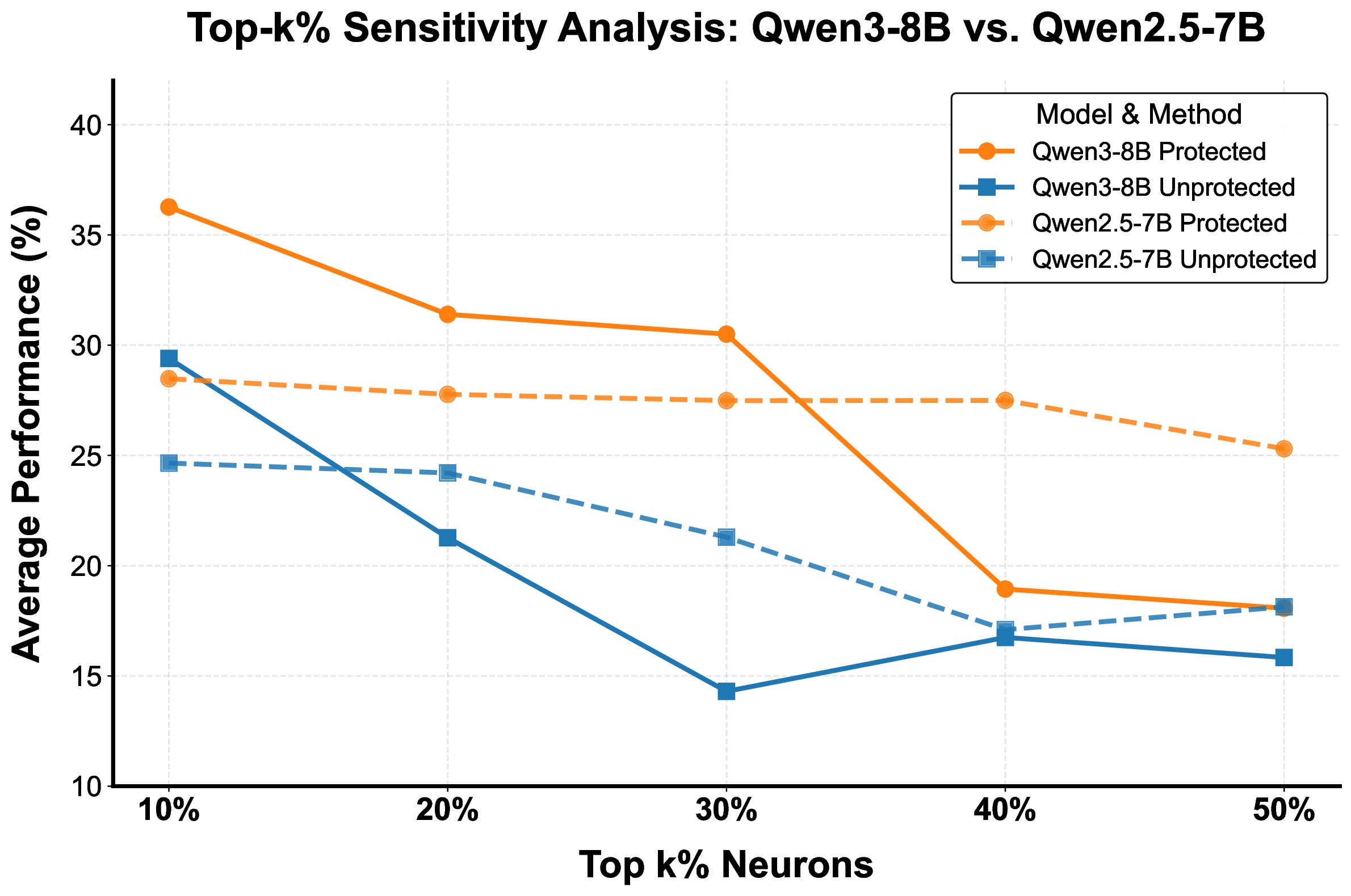
Only a small top-k% of donor neurons are grafted. Sensitivity analysis shows a broad stable range — the method is not balanced on a knife-edge.
The payoff
ARM merges three Simia benchmark-specialist experts into a single model and is evaluated across six aggregates — four in-domain suites (τ-bench, OfficeBench, WebShop, OS) and two held-out out-of-domain benchmarks (DB-bench, AlfWorld) — on both Qwen3-8B and Qwen2.5-7B expert pools.
Across both expert pools ARM is the strongest single merged model — average 44.6 (Qwen3-8B) and 45.7 (Qwen2.5-7B) — beating every training-free merge baseline and even the BEST-of-Three oracle expert selector (44.2 / 41.2), while preserving out-of-domain generalization to DB-bench and AlfWorld.
On Qwen3-8B, ARM reaches 44.6 mean over six aggregates — above every weight-space and activation-aware baseline, and above the oracle expert selector (44.2). On Qwen2.5-7B it reaches 45.7 (+10.9% over the oracle).
The gains are balanced rather than lopsided: ARM lifts the weakest suites instead of trading one for another, and it holds out-of-domain performance on DB-bench and AlfWorld — the benchmarks no expert was trained on.
ARM never runs gradient descent and never votes over answer strings. It screens merges by activation overlap and repairs the weakest suite by grafting a handful of role-salient neurons — evidence that role-critical circuits are a practical, training-free lever for robust multi-turn agent merging.
Built from 3 Simia experts · 2 model families · 6 aggregates Qwen3-8B · Qwen2.5-7B expert pools · in-domain: τ-bench · OfficeBench · WebShop · OS (AgentBench) · out-of-domain: DB-bench · AlfWorld
Watch
Cite
@misc{feng2026arm,
  title   = {ARM: Role-Conditioned Neuron Transplantation for
             Training-Free Generalist LLM Agent Merging},
  author  = {Feng, Zhuoka and Chen, Kang and Zhao, Sihan and Xiong, Kai and
             Wang, Yaoning and Yu, Minshen and Nian, Junjie and Xiao, Changyi and
             Cao, Yixin and Jiang, Yugang},
  year    = {2026},
  eprint  = {2601.07309},
  archivePrefix = {arXiv},
  primaryClass = {cs.CL},
  note    = {ARM (Agent-Role Merging). EMNLP 2026 (Main)},
  url     = {https://arxiv.org/abs/2601.07309},
}
Many specialists. One generalist — merged, not trained.